Solenoid Valve Troubleshooting Tips
1. Correct Installation Matters
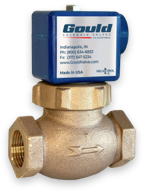
Gould Solenoid Valves must be installed properly to ensure reliable performance. Standard configuration requires installation in a horizontal line with the coil assembly mounted vertically on top. Some models and pipe sizes can be spring-loaded for alternate orientations, but without proper modifications, incorrect installation will prevent the valve from operating.
Always check the flow direction arrow on the valve body or IN-OUT stamp. Gould valves are engineered for one-way flow only. If you are unsure, contact our experts before installation.
2. Keep Valves Free of Debris
Foreign material, including particulates, pipe dope, or Teflon® tape, can jam moving parts or block small orifices, causing the valve to stick open or closed. Gould recommends installing at least a 40-mesh strainer upstream of the valve to filter out debris. Also, confirm that all piping is blown clean before installation.
3. Verify the Power Supply
Electrical compatibility is critical for solenoid valve performance:
- Match the supplied power with the voltage indicated on the valve nameplate.
- Gould solenoid valve lead wires are non-polar, either can connect to positive (+) or negative (-).
- The green wire, when supplied, must be grounded.
- Some valves cannot be converted from AC to DC (or vice versa) simply by changing the coil. Always verify compatibility.
Voltage should remain within +10% to -15% of the nominal rating. If the valve fails to actuate, check the coil leads for continuity. No continuity means the coil must be replaced. However, remember that a jammed or worn pilot assembly can cause coil burnout, so replacing the coil alone may not fix the underlying issue.
4. Minimum Differential Pressure Requirement
For piston-pilot operated valves (Types B, D, K, M, and Q), a minimum differential pressure of 5, 10, or 20 PSI (as stated on the nameplate) must be maintained.
- In normally closed valves, energizing the coil lifts the pilot valve off the seat, relieving pressure above the piston and allowing inlet pressure to lift the piston.
- When de-energized, the pilot closes and the piston spring returns the main valve orifice to the closed position.
If the system cannot maintain minimum differential pressure, the valve will not operate correctly.
5. Follow a Preventive Maintenance Schedule
Routine inspection and cleaning extend valve life. Gould recommends maintenance every 3 months or 10,000 cycles, though intervals vary with media type, cycle rate, and fluid velocity. Add solenoid valves to your facility’s scheduled maintenance program to prevent unexpected downtime.
Expert Support from Gould
Since 1951, Gould Solenoid Valves has been manufacturing American-made valves built for long-term performance. With four generations of experience and employees who bring decades of application knowledge, we can troubleshoot nearly any issue you encounter.
If your solenoid valve is not performing as expected, contact our experts by phone or email. We are here to help you keep your systems running reliably.