The Total Cost of Ownership Reality: Why Cheap Solenoid Valves Cost You More
Purchase price protects the spreadsheet. Total cost determines what actually happens next.
Procurement teams are under constant pressure to reduce costs. Budgets are tight, competition is fierce, and every line item is scrutinized. On paper, choosing the lowest-priced solenoid valve often looks like the responsible decision.
But in real operating environments—manufacturing plants, municipal systems, and multi-site facilities—purchase price is rarely the cost that matters most.
The real costs show up later. They show up as downtime. As emergency freight. As maintenance labor pulled away from planned work. As compliance questions that slow projects down. As inventory buffers added “just in case.”
This is the gap between what a valve costs and what a valve causes.
That gap is Total Cost of Ownership (TCO).
This article is not about teaching you what TCO is. You already know that. It’s about explaining why low-cost solenoid valves repeatedly create high-cost outcomes, who ends up absorbing those costs, and how procurement leaders can make valve decisions that reduce risk instead of inheriting it.
The uncomfortable truth about “lowest price” decisions
Most solenoid valves don’t fail immediately. They fail later—often after warranties expire, budgets reset, and responsibility has shifted.
That’s why low-cost valves keep winning bids.
The risk is delayed.
And when that risk materializes, the cost rarely lands back on the original purchase decision. It lands elsewhere:
- Operations absorbs the downtime
- Maintenance absorbs the labor
- Procurement absorbs the emergency sourcing
- Finance absorbs the unplanned expense
- Leadership absorbs the missed targets
No single department “owns” the full cost, which makes it dangerously easy to repeat the cycle.
This is exactly why procurement organizations rely on Total Cost of Ownership frameworks. Not to justify spending more—but to avoid paying more later, quietly, and repeatedly.
Where solenoid valve costs actually accumulate
When a solenoid valve is installed in a real system, its lifecycle cost is shaped by five practical realities. These are the areas where “cheap” most often becomes expensive.
1. Downtime is the real multiplier
Downtime is not theoretical. It is the most expensive outcome tied to valve failure, and it compounds quickly.
When a valve fails in a critical application:
- Production slows or stops
- Operators wait
- Maintenance responds
- Schedules shift
- Overtime begins
- Deliveries slip
- Managers get involved
Industry research consistently reinforces how costly unplanned downtime can be across manufacturing and infrastructure environments. The exact number varies by operation—but the pattern is universal: downtime costs dwarf component price.
Procurement implication:
If a valve choice increases the likelihood of failure—or increases the time it takes to recover when failure occurs—the unit price advantage disappears fast.
2. Maintenance labor isn’t “free”
A common blind spot in purchasing decisions is internal labor. Maintenance work doesn’t generate invoices, so it often disappears from cost comparisons.
But every valve failure requires:
- Troubleshooting
- Lockout/tagout
- Removal and replacement
- Verification and restart
- Documentation
Even when maintenance staff are salaried, their time still has value—and opportunity cost. Time spent reacting to failures is time not spent on preventive work, system improvement, or planned shutdowns.
Plant managers feel this immediately. Procurement often sees it only after patterns emerge.
Procurement implication:
Valves that require frequent intervention increase operating cost even if they were inexpensive to buy.
3. Emergency sourcing and expedited freight
When a critical valve fails, and the correct replacement isn’t readily available, normal purchasing behavior disappears.
Instead, teams pay for:
- Overnight freight
- Courier services
- Substitutes that “almost fit”
- One-off approvals and exceptions
These are not rare events. They are predictable outcomes when reliability and availability are inconsistent.
This is where supplier responsiveness becomes part of TCO. Availability, inventory depth, and spec-matching support directly influence how much panic spend an organization incurs over time.
Procurement implication:
Emergency freight is not bad luck—it’s a lifecycle cost driven by earlier decisions.
4. Inventory buffers hide reliability problems
Another common response to unreliable valves is stocking more spares.
At first, this feels prudent. But inventory has its own cost:
- Capital tied up
- Storage and handling
- Obsolescence risk
- Administrative overhead
Inventory carrying cost is real, ongoing, and often underestimated.
Procurement implication:
If you need excess inventory to compensate for valve reliability or lead time uncertainty, you are paying a hidden tax to manage risk that could have been designed out.
5. Compliance and sourcing complexity (municipal & public-sector)
For municipal systems and infrastructure projects, solenoid valve decisions carry an additional layer of responsibility.
Programs governed by American Iron and Steel (AIS) and Build America, Buy America (BABA) requirements impose domestic sourcing and documentation expectations that don’t disappear after installation.
Valves are explicitly included in AIS product categories, and BABA establishes domestic content preferences for federally funded infrastructure projects.
In these environments, “Will this work?” is not enough. The real questions are:
- Can this be documented?
- Can this be defended in an audit?
- Will this delay the project if questions arise?
Procurement implication:
Compliance uncertainty is a cost—measured in delays, rework, and risk exposure.
A familiar scenario: how cheap valves become expensive
Consider a realistic situation that plays out across plants and facilities every year.
A solenoid valve is selected primarily on price. It meets basic specifications. It’s installed. Everything runs—until it doesn’t.
Months later, the valve begins sticking intermittently. Operators notice inconsistent performance. Maintenance is called. The issue isn’t immediately obvious.
Eventually, the valve fails during production.
What follows is predictable:
- The line is isolated
- Maintenance troubleshoots
- Replacement is needed
- The exact valve isn’t in stock
- Freight is expedited
- The line waits
- Production recovers late
From a procurement standpoint, the valve “worked” for over a year.
From an operational standpoint, the valve just triggered:
- Downtime
- Labor costs
- Expedited shipping
- Schedule disruption
- Management escalation
This is not a failure of maintenance or operations. It is the natural outcome of buying components based on purchase price alone in critical systems.
Why Total Cost of Ownership matters more than ever
In today’s environment, organizations are under pressure to do more with less:
- Leaner maintenance teams
- Tighter capital budgets
- Higher uptime expectations
- Greater compliance scrutiny
This makes predictability more valuable than ever.
TCO is not about buying the most expensive option. It is about buying:
- Fewer surprises
- Fewer emergencies
- Fewer unplanned costs
- Fewer internal battles over responsibility
For procurement leaders, TCO is how you shift from defending line items to managing risk.
Where Gould Solenoid Valves change the equation
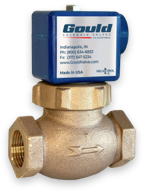
Gould Solenoid Valves are not a luxury upgrade. They are a risk-reduction strategy for organizations that care about lifecycle cost. Here’s how Gould aligns directly with the TCO problems described above.
Built for durability and consistency
Gould solenoid valves are manufactured in Indianapolis, Indiana, using cast valve bodies and precision-machined components designed for long-term service in demanding environments.
Consistency matters. When valves behave predictably across installations, maintenance teams spend less time diagnosing, less time reacting, and less time firefighting.
TCO impact:
- Fewer unplanned failures
- Reduced maintenance intervention
- More predictable performance over time
Faster recovery when issues arise
No valve lasts forever. What matters is how quickly you can recover.
Gould maintains a large in-stock inventory and focuses on fast spec-matching and replacement support. That reduces:
- Downtime duration
- Emergency sourcing
- Panic substitutions
TCO impact:
- Shorter outages
- Fewer expedited shipments
- Less operational disruption
Designed for standardization across systems
For fleet operators, facility chains, and multi-site organizations, variability is expensive.
Gould’s broad catalog of two-way solenoid valves allows organizations to standardize across applications without relying on inconsistent imports or one-off solutions.
TCO impact:
- Simplified spares
- Easier training
- Lower inventory complexity
Positioned for municipal and government procurement
Gould explicitly positions its valves for AIS and BABA-related projects, supporting domestic sourcing expectations and documentation needs for water, wastewater, and infrastructure environments.
TCO impact:
- Reduced compliance friction
- Lower risk of procurement delays
- Greater confidence in audit scenarios
For municipal directors and public-sector buyers, this is not a marketing feature—it’s operational protection.
What procurement leaders can do differently
You don’t need to overhaul your entire sourcing strategy. You need to be selective about where TCO truly matters.
Start here:
Identify critical applications
Focus TCO analysis on valves that:
- Affect uptime
- Affect safety or compliance
- Have failed repeatedly
- Trigger emergency behavior when they fail
Change the evaluation conversation
Instead of asking only “What does it cost?” ask:
- How often does this fail in similar environments?
- How quickly can we replace it?
- What happens if it fails at the worst possible time?
- What documentation is required for this project?
Standardize where possible
Standardization reduces:
- Failure variability
- Inventory burden
- Training time
- Emergency decision-making
Use TCO as a protection tool, not a justification
TCO is not about spending more. It’s about preventing avoidable cost. When framed correctly, it protects procurement from inheriting operational risk it didn’t create.
The Bottom Line
Cheap solenoid valves don’t always cost more. But in critical systems, municipal infrastructure, and uptime-driven operations, they often do.
They cost more in:
- Downtime
- Labor
- Freight
- Inventory
- Compliance risk
Total Cost of Ownership exists because these costs are real, recurring, and too often ignored at the point of purchase.
Gould Solenoid Valves are built for organizations that want fewer surprises, faster recovery, and lower lifecycle risk—not just a lower number on a purchase order.
If your responsibility extends beyond the PO—and for most procurement leaders, it does—then TCO isn’t optional. It’s essential.
Evaluating solenoid valves for a critical system or an AIS/BABA-funded project?
Gould can help you select the right valve, reduce lifecycle risk, and build a defensible Total Cost of Ownership case—before problems become emergencies.