System Reliability and Operational Efficiency in Wastewater Treatment: The Role of Solenoid Valve Design
Water and wastewater treatment facilities are among the most energy-intensive operations in municipal infrastructure. Pumps, blowers, and aeration systems account for the majority of that demand, often operating continuously to maintain process performance.
But energy consumption is only one part of system efficiency.
Facilities are also managing:
- Continuous operation requirements
- Aging infrastructure
- Maintenance labor constraints
- Pressure variability across processes
- The need for consistent, predictable performance
In this environment, operational efficiency is closely tied to system reliability.
Unplanned downtime, leakage, pressure instability, and premature component failure all introduce inefficiencies that impact maintenance schedules, system performance, and long-term infrastructure life.
While solenoid valves are not primary energy consumers, their design and performance influence how reliably a system operates over time.
Valve behavior affects pressure control, sealing performance, and mechanical stress throughout the system—making it an important factor in maintaining stable wastewater operations.
Efficiency in Wastewater Systems Extends Beyond Energy Consumption
When evaluating efficiency in treatment facilities, it is common to focus on large energy drivers such as pumps and aeration systems.
Those systems are critical, and their optimization has a direct impact on energy use.
However, system efficiency is also influenced by how consistently the process operates.
In practice, inefficiencies often appear as:
- Repeated maintenance on valves, seals, and joints
- Leakage that affects process control
- Pressure fluctuations during flow transitions
- Component wear driven by mechanical stress
- Service interruptions caused by system instability
These issues do not always show up in energy reports, but they directly affect labor, uptime, and overall system performance.
In wastewater treatment environments—where systems operate continuously—small disruptions that occur frequently can have a measurable impact over time.
Maintaining stable operation reduces variability and helps prevent compounding maintenance issues.
How Valve Design Influences System Stability and Performance
Solenoid valves are installed throughout wastewater treatment systems, but their impact is often only noticed when something starts going wrong.
In continuous-duty environments, valve performance doesn’t just control flow—it influences how stable the system behaves over time.
When valve operation is not aligned with system conditions, the effects tend to show up elsewhere first.
Controlled Operation and Pressure Behavior
In wastewater systems with long pipe runs or elevation changes, how quickly a valve closes matters.
A fast-closing valve can force the moving fluid column to stop abruptly. That sudden change in velocity creates a pressure wave that travels through the system and reflects at elbows, tees, and fittings.
Over time, this can lead to:
- Loosened flange connections
- Recurring gasket replacement
- Pipe vibration during actuation
- Stress on downstream instrumentation
In many facilities, these issues are treated as isolated maintenance problems. In reality, they are often symptoms of repeated transient pressure events.
Pilot-operated piston valves behave differently.
Because they rely on system pressure to actuate, they tend to close in a more controlled manner than fast-acting designs. This helps reduce abrupt flow stoppage and limits the intensity of pressure fluctuations in larger systems.
This behavior is especially relevant in systems where pressure shock is already a concern. (For a deeper breakdown of this topic, see our article on water hammer in wastewater treatment systems.)
Sealing Performance and Leakage Control
Leakage in wastewater systems is not always immediately visible, but it affects process control and system performance.
Over time, worn seats, degraded seals, or inconsistent tolerances can allow small amounts of flow to pass when a valve is closed.
This can result in:
- Difficulty maintaining precise chemical dosing
- Gradual loss of system pressure
- Additional cycling of pumps or controls
- Time spent troubleshooting inconsistencies
Consistent sealing performance depends on:
- Precision-machined internal components
- Proper seal material selection
- Stable operation under system pressure
Maintaining tight shutoff over repeated cycles reduces the need for frequent adjustment or replacement.
Durability in Continuous and Harsh Environments
Wastewater treatment systems expose valves to conditions that accelerate wear:
- Continuous operation
- High cycle frequency
- Moisture and humidity
- Chemical exposure
- Temperature variation
Valves that are not designed for these conditions may require replacement more frequently, even if they meet initial specifications.
This often shows up as:
- Replacing the same valve on a recurring schedule
- Increased spare parts inventory
- Maintenance teams addressing similar failures across multiple locations
Material selection plays a critical role here.
Stainless steel and 316 stainless steel valves are commonly used in wastewater applications because they provide corrosion resistance in more aggressive environments. (For more detail on material selection, see our comparison of bronze vs. 316 stainless steel valves.)
Durability is not just about avoiding failure—it’s about reducing how often the same issue needs to be addressed.
Impact on System-Wide Mechanical Stress
Valve operation does not happen in isolation.
Each actuation introduces a change in system conditions. Over time, repeated instability at control points can contribute to wear in other parts of the system.
This includes:
- Pumps compensating for pressure variation
- Increased load on seals and joints
- Instrumentation requiring recalibration
- Vibration in piping systems
When valves operate consistently and predictably, these downstream effects are reduced.
In systems that run continuously, small improvements in stability can reduce cumulative wear across multiple components.
Field Indicators: When Valve Performance Is Affecting Your System
In many cases, valve-related issues are not identified directly—they appear as recurring maintenance patterns.
Facilities may want to evaluate valve performance if they observe:
- Repeated gasket or seal replacement at the same locations
- Audible shock or vibration during valve actuation
- Loosened flanges or connections over time
- Difficulty maintaining stable process conditions
- Valves being replaced more frequently than expected
- Pump or instrumentation issues that coincide with flow changes
These conditions do not always point to a single root cause, but they often indicate that flow transitions and pressure behavior should be reviewed.
Evaluating valve type, closing characteristics, and material selection can help determine whether instability is being introduced at the control point.
Lifecycle Performance and Maintenance Considerations
In wastewater treatment facilities, equipment decisions are often evaluated over years—not months.
Solenoid valves that operate reliably over extended periods reduce the frequency of:
- Maintenance interventions
- Replacement cycles
- Troubleshooting time
- System disruptions
Over time, this contributes to more predictable operation and better use of maintenance resources.
Rather than focusing solely on component specifications, many facilities evaluate how a valve performs across its full service life.
This includes:
- How consistently it seals over time
- How it behaves under repeated cycling
- How well it withstands environmental exposure
- How often it requires service or replacement
Valves that maintain stable performance reduce variability in the system and allow maintenance teams to focus on higher-priority issues.
Common Wastewater Applications Where Valve Performance Matters
Solenoid valves are used across multiple stages of wastewater treatment, often in systems that cycle frequently and operate under varying pressure conditions.
Understanding how valve performance affects each application helps ensure more stable operation and fewer maintenance issues over time.
Chemical Dosing Systems
Chemical dosing requires consistent, repeatable control.
Valves that do not fully seal or respond predictably can lead to:
- Inconsistent dosing rates
- Difficulty maintaining process targets
- Additional calibration or manual adjustment
In these applications, sealing performance and repeatability are critical. Material compatibility also plays an important role, particularly in systems handling chlorine or other treatment chemicals.
Pump Isolation and Control
Solenoid valves are often used to control or isolate flow around pumps and related equipment.
In these systems, valve behavior during opening and closing can influence:
- Pressure transitions
- Pump load conditions
- Mechanical stress on seals and fittings
Abrupt flow changes can introduce unnecessary strain on both the pump and surrounding infrastructure. More controlled valve operation helps maintain stability during cycling.
Fill, Drain, and Transfer Lines
Fill and drain operations are common throughout treatment facilities and often involve frequent actuation.
In these applications, facilities may experience:
- Repetitive cycling over long periods
- Exposure to varying fluid conditions
- Wear concentrated at specific control points
Durability and consistent performance become important in reducing how often valves need to be serviced or replaced.
Outdoor and High-Moisture Installations
Many wastewater systems operate in environments with:
- Continuous humidity
- Washdown conditions
- Outdoor exposure
These conditions increase the risk of corrosion and electrical failure if valves are not properly constructed for the environment.
Material selection and enclosure protection both contribute to long-term reliability in these installations.
Material Selection in Wastewater Applications
Material selection should be based on actual operating conditions within the system.
In wastewater treatment, this often includes:
- Moisture exposure
- Chemical dosing
- Temperature variation
- Outdoor or washdown environments
Common material considerations include:
- Cast bronze for less aggressive environments
- Stainless steel for improved corrosion resistance
- 316 stainless steel for more demanding chemical exposure
Selecting the appropriate material helps ensure consistent performance and reduces the likelihood of premature failure.
Material selection is not about choosing the most expensive option—it is about choosing the right material for the application.
Built for Consistent Performance in Demanding Environments
Wastewater treatment systems require components that perform consistently under real operating conditions—not just in controlled specifications.
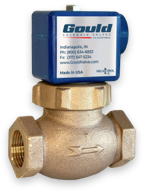
Gould Solenoid Valves are manufactured in Indianapolis using cast valve bodies and precision-machined internal components designed for long-term performance in continuous-duty environments.
Our valves are used across municipal, federal, and industrial systems where reliability is critical to maintaining operation.
Manufacturing Control and Material Integrity
Domestic manufacturing allows for tighter control over:
- Casting quality
- Machining tolerances
- Material consistency
- Assembly standards
Gould produces valves using cast bronze and 316 stainless steel bodies, selected based on application requirements and environmental exposure.
This level of control helps ensure consistent performance across installations, particularly in systems where variability leads to maintenance issues.
Compliance and Public Infrastructure Requirements
Many wastewater and water treatment projects are subject to procurement and compliance requirements.
Gould supports these applications as a:
- SAM-registered manufacturer
- Supplier to federal and government facilities
- Provider of AIS (American Iron and Steel) compliant valves
- Provider of BABA (Build America, Buy America Act) compliant valves
- Provider of TAA-compliant products
These requirements are often tied to funding and project approval. Having components that align with them simplifies the specification and procurement process.
Availability and Lead Time in Operational Environments
In wastewater systems, extended downtime is not always an option.
Gould maintains a large in-stock inventory of standard and ASCO-compatible two-way solenoid valves, allowing for:
- Faster replacement during maintenance events
- Reduced reliance on extended lead times
- Improved response during unexpected failures
This is particularly important in facilities where a single component delay can impact system operation.
Compatibility and Custom Application Support
Wastewater facilities often operate with a mix of legacy and newer equipment.
Gould manufactures ASCO-compatible solenoid valves designed for form, fit, and function replacement—allowing integration without requiring system redesign.
We also support custom-built configurations based on:
- Material requirements
- Voltage and coil specifications
- Seal compatibility
- Pressure and temperature conditions
This allows engineers and maintenance teams to match valve performance to actual system conditions, rather than adapting systems to fit a standard component.
Designed for Long-Term Operation
The focus in wastewater applications is not short-term performance—it is consistency over time.
Gould valves are built to:
- Withstand repeated cycling
- Maintain sealing performance
- Operate reliably under pressure
- Perform in corrosive and high-moisture environments
In systems that operate continuously, long-term stability reduces maintenance demands and supports more predictable operation.
Engineering Support and Specification Guidance
Selecting the right solenoid valve for a wastewater application is not always straightforward.
System conditions vary based on:
- Pressure and flow requirements
- Media type and chemical exposure
- Temperature range
- Installation orientation
- Cycle frequency
Matching a valve to these conditions helps ensure stable performance over time.
Gould works directly with engineers, plant managers, and maintenance teams to support:
- Specification matching for new installations
- Replacement of existing valves
- Evaluation of material compatibility
- Identification of performance issues in existing systems
Our team focuses on practical application fit—ensuring the valve performs as expected within the system it’s installed in.
If you’re evaluating valve performance or planning a replacement, we can help review your application and provide guidance based on operating conditions.
Conclusion: Stability Over Time Drives Real Efficiency
In wastewater treatment systems, efficiency is not defined by a single component or metric.
While large equipment drives energy consumption, system reliability determines how efficiently a facility operates over time.
Downtime, leakage, pressure instability, and repeated maintenance all introduce inefficiencies that affect performance and cost.
Solenoid valve design plays a role in these outcomes by influencing how fluid moves through the system and how consistently components perform under real operating conditions.
Facilities that prioritize stability, durability, and consistent operation are better positioned to reduce maintenance demands and maintain long-term system performance.
Because in continuous wastewater operations, efficiency is built over time—not just measured at a single point.
Need help matching a valve to your system?
If you’re dealing with recurring maintenance issues, pressure instability, or replacing valves more often than expected, it may be worth reviewing how the valve is performing within your system.
Gould Solenoid Valves provides:
- Spec matching for existing systems
- Guidance on material and configuration selection
- Support for wastewater and industrial applications
- Fast shipping from U.S.-based inventory