Solenoid Valves in Oil and Gas: Selection for Actuator Control, Chemical Injection, and Wellsite Reliability
In upstream and midstream oil and gas operations, a solenoid valve may be a relatively small component, but the system around it can depend on reliable operation.
A two-way solenoid valve may supply or isolate instrument air in a control circuit, start or stop flow through an applicable chemical-injection line, or control another process-fluid function. When the valve fails or the wrong replacement is installed, the result can be a control circuit that will not operate, a dosing skid that cannot run, or a remote site waiting on the correct replacement.
That is why selecting a solenoid valve requires more than matching pipe size and voltage.
Engineers and maintenance teams should evaluate:
- Operating pressure and pressure differential
- Media
- Flow requirements
- Normal position
- Valve body and wetted materials
- Seal compatibility
- Temperature
- Electrical requirements
- Hazardous-area classification
- Installation orientation
- Replacement availability
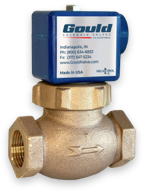
Gould Solenoid Valves specializes in industrial two-way solenoid valves. In oil and gas applications, Gould valves should be evaluated where a two-way configuration meets the control or process requirement.
This guide focuses on upstream and midstream process-control applications rather than gasoline, diesel, or fuel-oil transfer. For those applications, refer to Gould’s dedicated fuel-service valve information.
Where Two-Way Solenoid Valves Are Used in Oil and Gas Operations
Solenoid valves convert an electrical signal into fluid-control action. Depending on the application, that fluid may be clean, dry instrument air, water, oil, or another compatible process medium.
In an automated system, the valve can provide the interface between a PLC, RTU, or local control panel and the fluid circuit being controlled.
Three areas deserve particular attention in upstream and midstream operations.
Pneumatic Actuator and Instrument-Air Circuits
Pneumatic actuators are common throughout wellsites, pipeline systems, processing facilities, and other oil and gas operations.
Where a two-way solenoid valve is appropriate to the circuit design, it may be used to admit, isolate, or control instrument air serving a pilot or actuator-related function.
Start with the circuit requirements rather than the existing valve nameplate.
Confirm:
- Instrument-air supply pressure
- Required flow
- Port size and connection
- Coil voltage
- Available pressure differential
- Duty cycle
- Desired de-energized position
- Installation orientation
- Electrical area classification
- Whether the two-way solenoid is controlling air directly or serving another pilot function
Gould’s pilot-operated valve families use Velvetrol® internal piston architecture, which uses system pressure to operate the main valve element.
The available pressure differential matters. A pilot-operated valve must have sufficient differential pressure to operate correctly, and that requirement varies by series and pressure rating.
Chemical Injection and Low-Differential-Pressure Applications
Chemical-injection skids may be used to introduce corrosion inhibitors, methanol, scale inhibitors, biocides, and other treatment chemicals into oil and gas systems.
Valve selection should begin with the actual chemical and operating conditions.
Important variables include:
- Chemical composition and concentration
- Operating pressure
- Pressure differential
- Required flow
- Temperature
- Wetted materials
- Seal material
- Contamination
- Installation environment
For applications with zero or very low differential pressure, Gould’s QD and KD Series should be evaluated based on the specific operating requirements. Because low-differential-pressure service differs significantly from conventional pilot-operated valve selection, confirm the final application with Gould before specification.
Where adequate differential pressure is available and corrosion resistance is required, Gould’s stainless steel K and KX families may be relevant.
The K Series uses CF8M 316 stainless steel valve bodies. The KX Series goes further by providing 316 stainless steel construction for all wetted parts in standard KX configurations.
Chemical compatibility must always be evaluated across the complete wetted path, not the valve body alone.
Selecting Valve Materials for Oil and Gas Service
Bronze for Compatible Non-Corrosive Service
Bronze remains a practical material for many industrial fluid-control applications when the process medium and surrounding environment are compatible.
Gould’s bronze valve families use cast valve bodies designed for demanding industrial service.
But bronze should not be selected simply because an application is upstream or because a previous valve used a copper-based alloy.
Evaluate:
- Process media
- Water content
- Chlorides
- External corrosion exposure
- Temperature
- Pressure
- Chemical additives
- Project specifications
Material selection should follow the actual service conditions.
CF8M 316 Stainless Steel for Corrosive Applications
For corrosive environments, CF8M 316 stainless steel may provide a stronger material starting point.
Gould’s K and KX valve families use CF8M 316 stainless steel bodies, while KX configurations provide complete 316 stainless steel wetted construction.
That distinction matters.
A stainless steel body does not necessarily mean every internal wetted component is also 316 stainless steel.
What About H2S and Sour Service?
Sour-service applications require additional review.
Body material alone does not establish suitability for sour service.
Before specifying any solenoid valve for an H2S-containing environment, engineers should evaluate:
- Actual H2S exposure
- Water chemistry
- Chloride concentration
- Pressure
- Temperature
- Complete wetted construction
- Seal materials
- Owner or operator specifications
- Applicable project requirements
For these applications, confirm the complete valve construction and documentation with Gould before specification.
Hazardous Locations: Start With the Area Classification
Oil and gas facilities frequently contain electrically classified areas.
The correct enclosure should never be selected from a general assumption that a wellsite or process facility is “hazardous.”
Area classification comes from the facility’s engineering analysis, release sources, ventilation, process conditions, and applicable codes.
Obtain the project’s classified-area documentation first.
Then evaluate the solenoid valve accordingly.
Gould’s -2 Explosion-Proof Coil Housing Option
Gould offers a -2 explosion-proof coil housing option on applicable Q, K, KX, B, and D Series configurations.
The assembly is designed to meet:
- Class I, Division 2
- Class I, Group D
- Class II, Groups E, F, and G
- NEMA 7
- NEMA 4
- NEMA 5
For any hazardous-location application, verify that the exact valve configuration and enclosure match the project’s documented requirements.
NEMA designation alone should not be used as a substitute for reviewing the full electrical area classification.
Pilot-Operated Valve Selection and Differential Pressure
One of the most important operating variables in solenoid valve selection is pressure differential.
Gould’s pilot-operated K, KX, Q, B, D, and high-temperature families use Velvetrol® internal piston construction.
These valves rely on system pressure and require a minimum differential pressure across the valve for proper operation.
The required minimum varies by valve series and pressure configuration.
That makes differential pressure particularly important when specifying valves for:
- Low-pressure instrument systems
- Chemical-injection equipment
- Startup conditions
- Systems with variable upstream and downstream pressure
- Applications where downstream pressure can approach supply pressure
Do not assume that a valve rated for a particular maximum pressure will operate at any pressure differential below that rating.
Both maximum operating pressure and minimum differential pressure belong in the selection process.
Normally Closed vs. Normally Open: Start With the Process Requirement
“Normally closed” and “normally open” describe the solenoid valve’s position when the coil is de-energized.
They do not automatically define the final position of every piece of equipment connected to the control circuit.
For example, the final state of a pneumatically actuated process valve may also depend on:
- Actuator design
- Spring-return direction
- Air-circuit arrangement
- Other control components
- Shutdown logic
For safety-critical applications, begin with the process hazard and required de-energized state, then work backward through the complete control architecture.
Do not treat “normally closed” by itself as a complete fail-safe specification.
Closing Speed, Pressure Shock, and System Protection
Solenoid valve selection can also influence what happens elsewhere in the piping system.
Abrupt changes in liquid velocity can create hydraulic pressure transients commonly referred to as water hammer.
Those pressure spikes may stress:
- Pipe
- Fittings
- Connections
- Pumps
- Flow meters
- Pressure transmitters
- Other instrumentation
Gould’s Velvetrol® pilot-operated design provides controlled piston operation, and applicable Gould valve families can also be ordered with the -81 factory slow-close option to further reduce water hammer.
Closing behavior is therefore another specification variable worth considering in liquid systems where pressure transients are a concern.
The question is not simply whether the solenoid valve can withstand the system.
It is also how the valve’s operation affects the equipment around it.
Quick Selection Guide for Oil and Gas Applications
Application Requirement | Gould Series to Evaluate | Key Consideration |
|---|---|---|
Low or zero differential pressure | QD / KD / B4-21 | Confirm actual operating pressure and application requirements with Gould |
General stainless steel service | K Series | CF8M 316 stainless steel body; verify complete wetted construction |
Complete 316SS wetted construction | KX Series | Appropriate where greater wetted-material corrosion resistance is required |
High-pressure compact bronze applications | B Series | Available configurations extend into high-pressure liquid service |
Larger high-pressure bronze applications | D Series | Available in larger NPT sizes with high-pressure configurations |
High-temperature stainless applications | K-1 / KX-1 | Available for steam and other high-temperature compatible media |
Hazardous-location requirements | Applicable -2 configurations | Match exact enclosure configuration to documented area classification |
Water-hammer concerns | Applicable pilot-operated series with -81 option | Evaluate valve closing behavior as part of the system |
The table is a starting point, not a substitute for application review.
Final selection should account for the complete operating conditions.
Why Replacement Availability Matters at Remote Sites
A technically correct valve is only useful if it is available when the system needs it.
At a remote wellsite, processing facility, compressor location, or pipeline installation, an extended replacement lead time can turn a relatively small maintenance issue into a much longer operational problem.
Gould manufactures solenoid valves in Indianapolis, Indiana, and most standard configurations can ship within 24 hours.
That provides another option for maintenance teams facing long lead times on an existing valve.
Gould also offers a large selection of ASCO®-compatible two-way solenoid valves. When replacing an existing ASCO® valve, use Gould’s cross-reference tools as a starting point and then verify:
- Pipe size
- Port configuration
- Voltage
- Normal position
- Pressure
- Media
- Temperature
- Materials
- Enclosure requirements
- Installation conditions
Frequently Asked Questions
What type of solenoid valve should I use for an oil and gas pneumatic actuator circuit?
Start with the complete air circuit. Determine whether the application actually requires a two-way solenoid valve, then confirm supply pressure, required flow, pipe size, voltage, differential pressure, normal position, installation orientation, and hazardous-area requirements.
Where a two-way pilot-operated configuration is appropriate and adequate differential pressure is available, Gould offers several industrial valve families that can be evaluated.
What solenoid valve should I use for chemical injection?
Selection depends on the chemical, concentration, pressure, pressure differential, temperature, required flow, wetted materials, and seal compatibility.
For zero- or low-differential-pressure applications, Gould’s QD and KD Series may be appropriate to evaluate. For applications with adequate differential pressure requiring stainless steel construction, K or KX configurations may be relevant.
Confirm the final application with Gould before specification.
Do I need an explosion-proof solenoid valve at a wellsite?
Use the site’s documented electrical area classification to determine the enclosure requirement.
Gould’s -2 option is available on applicable Q, K, KX, B, and D Series configurations and is designed to meet Class I Division 2, Class I Group D, Class II Groups E/F/G, NEMA 7, NEMA 4, and NEMA 5 requirements.
Different site classifications may require a different solution.
Is 316 stainless steel automatically suitable for sour service?
No.
CF8M 316 stainless steel can be a useful material starting point for corrosive environments, but body material alone does not establish sour-service suitability.
Evaluate H2S exposure, water chemistry, chlorides, pressure, temperature, complete wetted construction, seal materials, and project-specific requirements before finalizing the valve.
Can Gould replace an ASCO® solenoid valve used in an oil and gas application?
In many two-way applications, Gould offers ASCO®-compatible alternatives.
Start with Gould’s ASCO® cross-reference information and then verify the exact operating requirements. Compatibility should be confirmed based on form, fit, function, media, pressure, temperature, materials, voltage, and enclosure.
Specify the Valve Around the Application
Oil and gas applications place very different demands on a solenoid valve depending on where and how it is being used.
The correct choice comes from understanding the complete operating condition—not simply finding a replacement with the same connection size and voltage.
Gould Solenoid Valves manufactures industrial two-way solenoid valves in Indianapolis using cast valve bodies and precision-machined components. Our team can help review operating pressure, differential pressure, media, material, voltage, enclosure, and other requirements to identify the right configuration.
Need help matching a valve to an oil and gas application?
Contact Gould’s team for specification support or use our ASCO® cross-reference tools to begin identifying a compatible replacement.