Class 1 Div 2 Solenoid Valves: How to Specify the Right Rating
If you’re looking for a Class 1 Div 2 solenoid valve, the good news is that it’s often the right fit for fuel, process and utility areas. The catch is that the rating has to match the spot where the valve will be installed, and that isn’t always the same thing the old nameplate says. We’ve built two-way solenoid valves in Indianapolis, Indiana, since 1951. In this guide, we’ll walk through what a Class I, Division 2 rating means, where it fits, and how to find a valve that matches it.
We’re focusing on two-way valves under the US Class, Division and Group system. Three-way and four-way valves, and equipment that needs ATEX or IECEx zone certification, are outside the scope of this guide.
What a Class 1 Div 2 Solenoid Valve Rating Means
A Class I, Division 2 solenoid valve is rated for areas where flammable gases or vapors are part of the process but normally stay contained. OSHA’s definition describes these as areas where the material “will normally be confined within closed containers or closed systems from which they can escape only in the event of accidental rupture or breakdown.”
Division 1 is the stricter classification. It covers areas where “ignitable concentrations of flammable gases or vapors may exist under normal operating conditions,” and it “usually includes locations where volatile flammable liquids or liquefied flammable gases are transferred from one container to another.”
This is why the area classification drawing tends to matter more than the application name. A single fuel facility can have both: the closed piping runs may be Division 2, while the transfer points may be Division 1. What counts is the classification right where your valve sits.
Gould’s -2 Housing: Rated Class I, Division 2
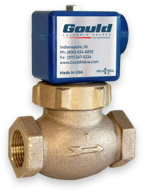
Our -2 housing is rated Class I, Division 2, Group D; Class II, Groups E, F and G; NEMA 4, 4X, 5 and 7 for hazardous locations under UL file E35048. It is not rated for Division 1.
You can get the -2 on the Q, Q-1, K, K-1, KX, KX-1 and B & D Series, and it comes standard on our Q-230 and K-230 fuel-service series. It isn’t offered on the M, M-1, B4-21 or BH-19.
That one housing handles the hazardous-location rating and the conditions around it:
- NEMA 4 and 4X: watertight and corrosion resistant, for washdown and outdoor service
- NEMA 5: dust-tight
- NEMA 7: explosion-proof construction
The housing is made of two machined, enamel-painted, sand-cast gray iron parts. They’re bolted together, threaded onto the bonnet assembly and rigidly cemented in place, so the housing won’t rotate once it’s assembled.
For maintenance teams, this means one enclosure spec can cover bronze, stainless and high-pressure valves in the same area. Fewer enclosure types on the shelf means fewer chances for the wrong one to end up on the line. Some series ship with a NEMA 1 coil as standard (KX, KX-1 and the normally open QR, KR, BR and DR). Most of our customers add the -2 to those valves just for its NEMA 4 and 4X protection.
Rating vs. Enclosure Type: Why the Certification Decides
This is where it’s easy to get tripped up. NEMA 250 defines Type 7 enclosures as “constructed for indoor use in hazardous (classified) locations classified as Class I, Division 1, Groups A, B, C, or D” (NEMA enclosure types). It’s natural to read “NEMA 7” and think “Division 1.” But an enclosure type describes how the housing is built. The approval is a separate thing.
OSHA asks that equipment “be approved not only for the class of location, but also for the ignitable or combustible properties of the specific gas, vapor, dust, or fiber that will be present,” and that it be “marked to show the class, group, and operating temperature or temperature range… for which it is approved” (OSHA 1910.307).
So the certification on the valve is what tells you where it can go. The NEMA number alone won’t. The rule also only works in one direction: “equipment that has been approved for a Division 1 location may be installed in a Division 2 location of the same class and group.” A Division 2 valve can’t step up to Division 1.
Dust works the same way. NEMA 250 lists Type 5 dust-tight among enclosures for non-hazardous locations, while “Class II solenoid valves are called dust-ignition proof” (Fluid Controls Institute). Keeping dust out and keeping dust from igniting are two different ratings. Our -2 housing carries both: NEMA 5 dust-tight construction and a UL listing for Class II, Groups E, F and G.
Choosing a Class 1 Div 2 Solenoid Valve by Application
Fuel Service: Gasoline, Diesel, #1 and #2 Fuel Oils
For fuel service, we build two series with the -2 housing as standard:
- Q-230 Series: cast bronze, 1/8” to 3” NPT, full port. Q-230: 5–100 psi, 220°F max. Q4-230: 5–150 psi, 300°F max.
- K-230 Series: investment-cast CF8M 316 stainless steel, 1/8” to 2” NPT, full port, 5–150 psi, -40°F to 300°F.
Both use Viton® seats and our Velvetrol® internal piston pilot operation, with a 1/2” NPT conduit connector on the coil housing. If you need a normally open valve, there’s the QR-230 (with Q4-230 ratings) and the KR-230. The 5–100 psi Q-230 comes normally closed only. The hazardous-location rating is the same on both series, so the choice between bronze and stainless usually comes down to what matches the rest of your piping.
Heating-oil season runs from October through March (EIA). If a fuel-oil valve is coming due for replacement, now is a good time to check its classification, well before a January failure makes the decision for you.
Air, Water and Process Lines
For other services, it usually helps to start with the series that suits your process conditions and then add the -2 housing:
Series | Body | Sizes | Operating pressure | Max fluid temp |
Q | Cast bronze | 1/8”–3” | Up to 10–400 PSI | 300°F (Q4) |
K | CF8M 316 SS | 1/8”–2” | 5–150, 10–400 or 20–1000 PSI | 300°F |
KX (all wetted parts 316 SS) | 316 SS | 1/8”–2” | 5–60, 5–150 or 10–300 PSI | 300°F |
B & D (closing speed adjustment, manual open, flow control) | Bronze | 1/4”–2” | 5–150, 10–400, 10–700 or 20–1200 PSI | Contact us for your configuration |
Q-1 / K-1 / KX-1 (high temperature) | Bronze or 316 SS | Varies by series | Q-1-3T: 5–150 PSI; Q4-1-3T, K-1-3T: 5–150, 10–200 or 10–400 PSI; KX-1: 5–150 PSI | Q-1: 365°F; Q4-1, K-1, KX-1: 450°F |
For high-temperature service, the Q-1-3T handles steam, hot water, hot oils and hot air at 5–150 PSI, and it’s UL listed for steam at 5–150 PSI. The Q4-1-3T and K-1-3T handle steam and high-temperature hot water, hot oils and hot air at 5–150 or 10–200 PSI, plus 10–400 PSI for hot water, hot oils and hot air.
The B & D Series can handle pressures up to 20–1200 PSI, but their real strength is control. Closing speed adjustment, manual open and flow control capabilities make them a good fit for many lines, not just high-pressure ones.
It’s worth matching your operating range rather than the body rating. K Series bodies, for example, are rated to 2500 PSI burst but built for application pressures up to 1000 PSI.
Replacing an ASCO® Hazardous-Location Valve
If you’re replacing an ASCO® valve, the prefix on the part number is a helpful starting point. ASCO® uses EE for “Class I, Division 2 General Purpose,” EF for “Class I, Division 1 Explosionproof,” and EV for EF “with 316 Stainless Steel Hub and Stainless Steel Base Plate” (Emerson ASCO® Optional Construction Features).
- ASCO® EE: our -2 housing is the closer match, since both are Class I, Division 2.
- ASCO® EF or EV in a Division 1 location: this isn’t a Gould application.
- ASCO® EF or EV where the area drawing shows Division 2: a Gould -2 valve may be a practical replacement.
Our ASCO® cross-reference guide can help you find the matching series. Gould is an independent manufacturer, not ASCO®.
Two Problems That Look Like a Bad Valve
The valve won’t open. Our -2 families and the -230 Series use our Velvetrol® internal piston pilot operation. Pilot-operated valves need a minimum pressure differential (ΔP) across the valve to open: 5, 10 or 20 PSI depending on the pressure range, and 5 psi on the -230 Series. Gravity-fed day tanks, tank bottom drains and lines where the pump hasn’t built pressure yet can fall below that. Before swapping the coil, it’s worth checking the ΔP first. Our direct-acting B4-21 and BH-19 need no minimum differential, though they aren’t offered with the -2 housing.
The line shakes when the valve closes. When a valve closes abruptly in a liquid line, it sends a pressure transient through fittings, meters and gauges. Our Velvetrol® technology delivers a soft, cushioned close that helps prevent water hammer. For long runs or sensitive instruments, the -81 Factory Slow Close Option can help further. It’s available at no additional charge on the Q, Q-1, K, K-1, KX, Q-230 and K-230.
Quick Reference
Condition | Gould series | Note |
Fuel in a Class I, Division 2 area | Q-230 or K-230 | -2 housing standard; Viton® seats |
Air, water or process line in a Class I, Division 2 area | Q, K, KX or B & D with -2 | Choose by pressure, size and material |
Need closing speed adjustment, manual open or flow control | B & D with -2 | Four ranges, from 5–150 to 20–1200 PSI |
High temperature or steam in a Class I, Division 2 area | Q-1, K-1 or KX-1 with -2 | Up to 365°F (Q-1) or 450°F (Q4-1, K-1, KX-1) |
Replacing ASCO® EE | Gould -2 | Closer match: both Class I, Division 2 |
Class I, Division 1 | Not a Gould -2 application | The -2 is rated Division 2 only |
Combustible dust (Class II, Groups E, F, G) | Q, K, KX or B & D with -2 | Share the Division and Group so we can confirm |
Low or zero ΔP | QD or KD Series | Quoted by the factory; see the pre-order checklist |
Three-way or four-way | Outside Gould’s two-way line | Contact us if two-way function will work |
Frequently Asked Questions
What is a Class 1 Div 2 solenoid valve? It’s a solenoid valve certified for Class I, Division 2 locations, where flammable gases or vapors are normally contained in closed systems and escape only through abnormal conditions such as a rupture. Gould’s -2 housing carries this rating, for Group D, under UL file E35048.
Can a Class 1 Div 2 solenoid valve be used in a Division 1 area? No. OSHA allows Division 1 equipment in Division 2 areas of the same class and group, but not the other way around. Gould’s -2 housing is rated Class I, Division 2 only.
What Class 1 Div 2 solenoid valve works for gasoline or diesel? Gould’s Q-230 (cast bronze) and K-230 (CF8M 316 SS) are built for gasoline, diesel and #1 and #2 fuel oils, with Viton® seats and the -2 housing as standard.
Can a Gould valve replace an ASCO® EF valve? Only if the valve’s location is classified Division 2, since ASCO® rates EF for Class I, Division 1. For ASCO® EE (Class I, Division 2) valves, the Gould -2 housing is the closer match.
Pre-Order Checklist: What to Send Gould
Our engineering team in Indianapolis is happy to review your application against our published ratings. When you share the items below along with the nameplate, we’ll confirm the match, or let you know honestly if a Gould valve isn’t the right fit.
- Class and Division at the valve location, taken from the area classification drawing rather than the old nameplate. Our -2 is rated Class I, Division 2 only.
- Group of the gas, vapor or dust present. Our -2 is listed for Class I, Group D and Class II, Groups E, F and G.
- Whether combustible dust (Class II) is present. NEMA 5 dust-tight isn’t a Class II rating on its own, so we’ll check your dust Group against our Class II listing.
- Ignition temperature of the material present, so our engineering team can review it against your exact configuration.
- ASCO® part number and prefix (EE, EF or EV), if you’re replacing an ASCO® valve.
- Media, operating pressure and minimum pressure differential. If ΔP is low or zero in a classified area, we can talk through our direct-acting QD and KD Series. Their configurations vary, so we quote them from the factory.
- Pipe size, body material, seat material, normally closed or normally open, and coil voltage.
- Installation details. The Fluid Controls Institute notes that “the use of a conduit seal is necessary” in hazardous locations. Our -230 coil housings have a 1/2” NPT conduit connector.
We’ve been building solenoid valves in Indianapolis since 1951, and most Gould valves ship within 24 to 48 hours of order receipt.
- Ready to find your valve match? Request a quote or call 800-634-6853
- Replacing an ASCO® valve? Try our cross-reference guide