Solenoid Valves for Chemical Processing: Selecting for Corrosive Media, Hazardous Locations, and Reliable Uptime
Specifying a solenoid valve for a water line and specifying one for a chemical plant are two fundamentally different engineering exercises. The consequences of getting it wrong differ by an order of magnitude.
In a standard water service application, an underspecified valve might leak or fail prematurely – an inconvenience. In a chemical processing environment, the same mistake can mean a corroded valve body releasing a hazardous fluid, an explosion-proof enclosure that doesn't meet the rating of the classified area, or a fast-closing valve driving pressure spikes through a corrosive line that destroys instrumentation worth more than the valve itself.
This guide covers the four variables that matter most when selecting solenoid valves for chemical processing: body material, seal material, NEMA enclosure rating, and valve operating principle. It also addresses water hammer: a problem that gets more serious, not less, when the fluid running through your lines is chemically aggressive.
Why Solenoid Valve Selection Is More Complex in Chemical Environments
Most industrial solenoid valves are designed and marketed for general-purpose service: water, air, light oils, steam. Those applications have one thing in common: the media is not actively trying to attack the valve.
Chemical processing environments are different. The media may be acidic, alkaline, oxidizing, reducing, or solvent-based. It may be flammable. It may be operating at elevated temperatures that accelerate corrosion. And the plant area itself may be classified as a hazardous location under the NEC, requiring explosion-proof electrical enclosures.
On top of that, chemical plants tend to operate on tight shutdown windows. Mid-year maintenance audits in Q2 and Q3 are common – the window to evaluate, order, and install replacement components before a summer turnaround is narrow. Specifying the right valve once, rather than replacing an incorrect one under time pressure, is the better engineering and procurement strategy.
The selection framework starts with four questions:
- What is the valve body in contact with, and what metal is compatible?
- What elastomers are in contact with the media, and are they chemically compatible?
- What is the electrical area classification of the installation location?
- What is the valve's operating principle, and does it match the pressure and flow requirements of the application?
Valve Body Materials: Matching Metal to Media
When Bronze Works & When It Doesn't
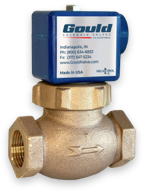
Cast bronze has been a reliable solenoid valve body material for over a century. It machines well, handles high pressures, and is resistant to many neutral fluids – water, air, steam, light oils, and aqueous solutions without significant acidity or oxidizing character.
In chemical service, however, bronze has meaningful limitations. It is susceptible to dezincification in the presence of certain chloride-containing solutions. Ammonia and ammonium compounds attack copper alloys aggressively. Strong acids, even dilute, will corrode bronze over time. Oxidizing acids such as nitric acid attack it rapidly.
If your chemical is neutral, non-chlorinated, and not copper-reactive, bronze may serve adequately. If there is any doubt about media compatibility, it is not the right choice.
316 Stainless Steel: The Default for Corrosive Service
For chemical processing applications involving corrosive media, 316 stainless steel (CF8M investment cast) is the standard starting point. The molybdenum content in 316 SS – roughly 2–3% – dramatically improves resistance to pitting and crevice corrosion compared to 304 SS, particularly in chloride environments.
316 SS is resistant to a broad range of dilute acids, alkaline solutions, many solvents, and chloride-containing media. It performs well in oxidizing environments that would attack copper alloys. Investment-cast CF8M construction, as used in Gould's K & KX Series, provides wall integrity and dimensional consistency that sand-cast alternatives cannot match.
Important exceptions: 316 SS is not appropriate for service with concentrated hydrochloric acid, hydrofluoric acid, or high-temperature sulfuric acid above dilute concentrations. For those applications, more exotic alloys (Hastelloy, Duplex SS) or lined valve bodies are required. Always verify compatibility with a corrosion chart specific to your media concentration and temperature.
When all wetted parts – body, bonnet, piston assembly, springs, and pilot components – are 316 SS, you eliminate the galvanic corrosion risk that arises from mixed metallurgy. This is the construction used in Gould's KX and KX-1 Series: complete 316 SS for all wetted parts, with CF8M bodies rated to 1,000 PSI.
Seal Material Selection for Chemical Compatibility
Even in a properly specified 316 SS valve, incorrect seal material selection can cause premature failure. Elastomers and PTFE seats are the weak point in chemical service – a seal that swells, degrades, or loses elasticity in contact with the process fluid will compromise the valve's ability to shut off cleanly.
Buna-N (NBR): Standard Service
Buna-N, or nitrile rubber, is the most common seal material in general-purpose solenoid valves. It offers good resistance to petroleum-based oils, fuels, and many aqueous solutions. Temperature range is typically -40°F to 250°F.
Buna-N is not suitable for use with ketones (acetone, MEK), esters, chlorinated solvents, strong acids, or ozone. In chemical plants where any of these media are present, Buna-N should not be the default seal selection.
Viton® (FKM): Oils, Fuels, and Many Solvents
Viton® fluoroelastomer provides significantly broader chemical resistance than Buna-N, including compatibility with aliphatic and aromatic hydrocarbons, chlorinated solvents, fuels, and many acids. It performs to approximately 400°F.
Viton® is the go-to seal material for petroleum refining, fuel handling, solvent-based chemical processes, and applications where the media is ambiguous or may vary. Its resistance to swell in hydrocarbon environments makes it the preferred choice in most petrochemical and specialty chemical applications.
Limitations: Viton® does not perform well with ketones, low-molecular-weight esters, or highly polar solvents. It is also not recommended for steam service above approximately 350°F.
PTFE: Broad Chemical Resistance
PTFE (polytetrafluoroethylene) offers the broadest chemical resistance of any standard seal material. It is inert to virtually all acids, alkalis, solvents, and oxidizing agents, and operates across an exceptionally wide temperature range (-320°F to 500°F). It does not swell, degrade, or absorb fluids.
The tradeoff is mechanical: PTFE is not elastic. It cannot provide the compression sealing that rubber elastomers deliver, and it will cold-flow under sustained load. In highly aggressive chemical service – concentrated acids, strong oxidizers, aggressive alkalis – PTFE is often the only appropriate seat material.
EPDM: Alkalis and Steam
Ethylene propylene diene monomer (EPDM) rubber performs well in alkaline environments, hot water, and steam service. It is also resistant to many ketones and polar solvents that attack Viton®. Temperature range extends to approximately 300°F in water service.
EPDM is not compatible with petroleum products, nonpolar solvents, or oils. In chemical plants with alkali cleaning circuits, caustic service, or steam-heated systems, EPDM is often the correct elastomer choice.
NEMA Enclosure Ratings in Chemical Plant Environments
The valve body and seal handle the wetted process. The coil and electrical enclosure must handle the external environment – which in a chemical plant may involve wash-down, corrosive vapors, or classified electrical areas.
NEMA 4X: The Corrosion-Resistant Standard
NEMA 4X enclosures provide protection against water ingress from any direction, dust, splashing, and corrosive environments. For outdoor chemical plant installations, wash-down environments, areas with corrosive vapors that aren't in classified electrical zones, and coastal or high-humidity environments, NEMA 4X is the appropriate minimum specification.
NEMA 7: Explosion-Proof for Hazardous Locations (Class I, Div 1/2)
Where flammable gases or vapors may be present in the atmosphere, the NEC classifies those areas as Class I locations. Division 1 covers areas where hazardous concentrations exist under normal operating conditions; Division 2 covers areas where they exist only under abnormal conditions.
For explosion-proof (-2) options, Gould’s Q, K, KX, B & D Series all use a machined, enamel-painted sand-cast gray iron housing that meets Class I, Div 2, Class I Group D, and Class 2 Group E/F/G ratings, while also meeting NEMA 4, NEMA 5, and NEMA 7 requirements in a single assembly.
Direct-Acting vs. Pilot-Operated Valves in Chemical Service
Direct-acting valves can operate at zero differential pressure and are appropriate for small pipe sizes. The main seal is directly connected to the solenoid plunger, so closure is fast and binary.
Pilot-operated valves require a minimum differential pressure (typically 5 PSI) to operate correctly, but provide significant advantages for larger sizes and demanding service: much lower coil wattage, larger pipe sizes, and graduated closure action through hydraulic dampening – critical for water hammer mitigation.
In most chemical plant applications involving ½" pipe and larger, pilot-operated valves are the correct choice. All Gould valves (other than direct acting) use pilot-operated Velvetrol® internal piston architecture as standard across all sizes.
Water Hammer in Chemical Processing Lines
Water hammer, the pressure surge caused by sudden flow stoppage, is a well-known problem in water and wastewater systems. It is less discussed in chemical processing, but the risk is at least as significant.
Chemical process lines are often more rigid than water distribution piping. Instrumentation (pressure transmitters, flow meters, analytical sensors) is more prevalent and more expensive. The physics are governed by the Joukowsky equation: a system running at 5 ft/s at 60 PSI can experience a surge to 360 PSI in milliseconds when a valve closes instantaneously. Standard direct-acting solenoid valves close in 25–30 milliseconds – fast enough to generate the full Joukowsky surge.
Gould's Velvetrol® technology addresses this at the valve architecture level. The internal piston pilot-operated design closes gradually – the pilot orifice closes first, then system pressure builds over the piston through a controlled bleed, and the main piston seats progressively. Testing of Velvetrol®-equipped valves has demonstrated pressure peaks of 265 PSI or less in conditions where comparable direct-acting valves generate 1,400 PSI spikes – a reduction of approximately 80%.
For high-risk applications, Gould offers the -81 slow-close factory option, which extends closure time.
Why American-Made Matters for Chemical Plant Specifications
Gould manufactures its complete solenoid valve line in Indianapolis, Indiana – satisfying AIS (American Iron and Steel) and BABA (Build America, Buy America) compliance requirements for federally funded projects.
Lead time. Gould ships within 24 hours on standard configurations. The contrast with offshore-manufactured alternatives – where lead times of 12–18 weeks have not been unusual – is the difference between completing a planned maintenance window and extending a shutdown.
Traceability. Chemical plants operating under PSM or RMP requirements need to document materials of construction. American-manufactured valves with domestic engineering documentation provide a cleaner paper trail.
Gould's fourth-generation family ownership and 75-year manufacturing history in Indianapolis means the company and its documentation are accessible when engineers need to verify a material certification for a PSM review.
Frequently Asked Questions
What solenoid valve material is best for corrosive chemical media?
For most corrosive chemical service, 316 stainless steel (CF8M investment cast) is the standard body material. Bronze is appropriate for non-aggressive, non-chlorinated neutral fluids but should not be the default choice in chemical plants. Seal material selection is equally important – match the elastomer (Viton®, PTFE, EPDM, Buna-N) to your specific media using a corrosion compatibility chart.
Do I need an explosion-proof solenoid valve in my chemical plant?
If the installation location is classified as a Class I, Division 1 or Division 2 area under the NEC – meaning flammable gases or vapors may be present – then yes, you require an explosion-proof solenoid valve enclosure rated NEMA 7 for the applicable Group. Review your facility's area classification drawings before specifying any electrical component.
How do I prevent water hammer in chemical processing lines?
The most effective control is valve selection. Pilot-operated solenoid valves with graduated closure characteristics, such as Gould's Velvetrol®-equipped valves, prevent the sudden flow stoppage that generates hydraulic shock. For high-risk applications, specify the slow-close (-81) factory option, which extends closure time.
What is the difference between NEMA 4X and NEMA 7 for solenoid valves?
NEMA 4X specifies protection against water ingress, dust, and corrosive environments. NEMA 7 specifies explosion-proof construction for Class I hazardous locations where flammable gases or vapors may exist. Some explosion-proof enclosures, including Gould's -2 option, simultaneously meet NEMA 4, NEMA 5, and NEMA 7 ratings.
Can I get a Gould solenoid valve to replace my ASCO® valve in a chemical plant application?
Yes. Gould's K & KX Series 316 SS pilot-operated valves are designed to be compatible with ASCO® valve configurations and are frequently used as drop-in replacements in chemical plant applications. Contact Gould directly with your existing valve model number and application data to confirm the right specification.
Ready to specify the right valve for your chemical process? Contact Gould's engineering team or browse our 316 SS and explosion-proof product lines at gouldvalve.com/industries