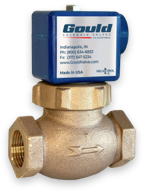
Solenoid Valves for Commercial Irrigation: Sizing, Water Hammer, and Keeping Systems Running at Peak Season
A residential sprinkler valve and a commercial irrigation solenoid valve may look similar from across the field, but they aren't the same category of component. One operates a quarter-acre of turf at a few gallons per minute. The other governs zones of a center-pivot system, a golf course's back nine, or a hundred acres of drip tape – often at flow rates, pressures, and duty cycles that would destroy a valve built for a homeowner's timer box.
By August, that difference stops being theoretical. Corn, soybeans, cotton, and vegetable operations are running irrigation at or near maximum duty cycle to keep up with evapotranspiration demand. Every valve in every one of those systems is working harder in August than in any other month – and every valve that fails during this window creates a problem well beyond a maintenance ticket.
This guide covers what matters when selecting a solenoid valve for commercial and agricultural-scale irrigation: valve architecture, sizing, water hammer risk, and material selection – plus why availability itself becomes a design consideration in peak season.
Why Commercial Irrigation Demands More Than a Residential Valve
Residential irrigation valves are built for low flow, low pressure, and forgiving duty cycles. Most are plastic-bodied, diaphragm-actuated, and rated for a handful of psi differential and a few dozen cycles per season. Commercial and agricultural systems operate in a different envelope entirely:
- Higher flow volumes. A single zone on a large pivot or drip block can move hundreds of GPM, versus 10–20 GPM residential.
- Higher, more variable pressure. Sources deliver 40 to over 150 PSI; booster pumps add their own transients.
- Long pipe runs. Laterals and mainlines extend hundreds to thousands of feet – a factor for water hammer risk.
- High cycle counts. Automated multi-zone systems run a valve through thousands of cycles per season.
- Continuous outdoor exposure. UV, temperature swings, dust, and sediment act on the body, seals, and coil enclosure over years of unattended service.
A valve not built for this environment doesn't just underperform – it fails, usually when a failure costs the most.
Understanding the Valve Types Used in Commercial Irrigation
Direct-Acting Solenoid Valves: Smaller Lines, Simpler Systems
Direct-acting valves use the solenoid's magnetic force to lift the closure member directly off the seat, with no reliance on line pressure – they can function at zero differential pressure, useful for small-scale metering and fertigation dosing. The tradeoff is scale: because the solenoid does all the mechanical work, direct-acting valves are practical mainly at 1" and under. For small zone control and low-flow greenhouse fertigation, direct-acting valves (Gould's QD, KD & B4-21 Series) are the right tool; for mainline and zone valves feeding large-acreage systems, they generally are not.
Pilot-Operated Solenoid Valves: The Right Choice for Large-Scale Irrigation
Pilot-operated valves use a small solenoid to control a pilot orifice, which uses the system's own line pressure to open and close the main valve disc – letting a small, low-wattage solenoid control large flow volumes efficiently.
For commercial and agricultural systems, pilot-operated construction is the default choice above roughly 3/4" pipe size and the only practical one at 1-1/4" and larger. Gould's M and Q Series (M = ⅛"-2” up to 250psi & Q = ⅛"-3”npt up to 400psi) cover this range, as do the high-pressure B and D Series above 150 PSI. All use Gould's Velvetrol® internal piston pilot design as standard. One requirement: pilot-operated valves need a minimum pressure differential, typically 5 PSI, to function correctly – almost never a limiting factor in mainlines, but worth confirming on low-pressure gravity-fed systems.
Sizing a Solenoid Valve for an Irrigation System
Flow Rate and Cv
The flow coefficient (Cv) describes how much flow a valve passes at a given pressure drop. The relationship is Q = Cv × √(ΔP), where Q is flow rate in GPM and ΔP is pressure drop across the valve in PSI. Size to actual GPM requirements and acceptable pressure drop – not just pipe diameter. A 3/4" pilot-operated valve with a Cv of 7.5 can pass roughly 15 GPM at a 4 PSI drop – adequate for many drip zones, but undersized for a high-flow pivot lateral that may call for a 1-1/4"–2" valve (Cv 23–45).
Operating Pressure Range
Irrigation systems don't run at a single static pressure. Confirm both minimum and maximum differential the valve is rated for. Running a pilot-operated valve below its minimum ΔP requirement causes incomplete actuation – showing up as inconsistent zone performance before it becomes a hard failure.
Pipe Size and Connection
Match the NPT connection to your pipe size, but treat this as a starting point. Cv, not raw pipe diameter, determines whether the valve delivers the flow your zone needs.
Water Hammer in Commercial Irrigation Pipelines
Why Irrigation Systems Are Particularly Vulnerable
Three factors compound the risk in large-scale irrigation: long pipe runs (pressure wave energy scales with fluid column mass and velocity), high flow volumes (more energy released when flow stops abruptly), and fast cycling (automated controllers repeatedly cycle valves, and cumulative fast-closure damage compounds even when no single event causes visible failure).
An abruptly stopped flow generates a pressure wave that can reach many times normal operating pressure in milliseconds – cracking PVC or HDPE, blowing gaskets, and damaging regulators costing far more than the valve that caused it.
How Velvetrol® Technology Addresses Water Hammer at the Source
Gould's Velvetrol® is a proprietary internal piston pilot-operated design, standard on all series other than direct acting valves. Rather than slamming the flow path shut, Velvetrol® uses a graduated pressure equalization – the pilot orifice actuates first, and the main piston closes progressively. For high-risk systems – very long laterals, elevated static head, or high-velocity zones – Gould offers the -81 factory slow-close option at no additional charge, extending closure time. For OEMs designing pivot control packages, specifying a slow-closing valve at the design stage is simpler and cheaper than retrofitting surge arrestors after repeated failures.
Material Selection for Irrigation Service
Bronze for Standard Fresh Water Service
Cast bronze is the proven standard for systems running fresh water from wells, canals, or municipal sources without significant treatment. Gould's M and Q Series bronze valves, along with the high-pressure B and D Series, cover the majority of standard fresh-water irrigation applications.
316 Stainless Steel for Treated, Reclaimed, or Chemically Dosed Water
Reclaimed water on municipal turf often carries higher chloride content. Fertigation systems inject fertilizers directly into the line, some corrosive to bronze over time, and coastal agriculture may draw on water with elevated salinity. In these cases, 316 stainless steel is the more durable choice. Gould's KX Series, built in complete 316 stainless steel across all wetted parts, holds up where bronze would degrade over years of service.
Why Availability Matters More in August Than Any Other Month
August is peak evapotranspiration demand across most row-crop and specialty-crop growing regions. A failed zone valve during a critical growth window is a direct risk to yield – a few days of inadequate water can mean measurable crop loss for high-value specialty crops.
Many manufacturers operate on lead times measured in weeks. Gould manufactures its complete solenoid valve line in Indianapolis, Indiana, and ships standard configurations within 24 hours. For an operator facing an in-season failure, that's the difference between a valve on the truck tomorrow and a field without water for weeks. Gould's domestic manufacturing also satisfies AIS and BABA requirements increasingly applied to publicly funded irrigation infrastructure.
Frequently Asked Questions
What solenoid valve should I use for a commercial irrigation system?
A pilot-operated solenoid valve is the correct architecture for most commercial and agricultural irrigation. Size using Q = Cv × √ΔP, confirm the pressure range covers your system's minimum and maximum, and select bronze for fresh water or 316 stainless steel for reclaimed, saline, or chemically dosed water. Gould's M and Q Series bronze pilot-operated valves, and the KX Series in 316 stainless steel, cover this range.
How do I prevent water hammer in an irrigation pipeline?
Choose a pilot-operated valve with graduated, controlled closure. Gould's Velvetrol® design closes progressively – giving the pressure wave time to dissipate. For long laterals, high static head, or high-velocity zones, specify the factory slow-close (-81) option extending closure.
What is the best solenoid valve for a center pivot irrigation system?
A pilot-operated valve sized correctly by Cv – not just pipe diameter – is the starting point. Pivots combine long pipe runs, high flow, and frequent cycling, so a Velvetrol®-equipped valve matters as much as raw flow capacity. Match material to water source: bronze for fresh water, KX Series 316 stainless steel for reclaimed, saline, or chemically treated water.
Why do solenoid valves fail in irrigation systems?
The most common causes are undersizing, water hammer damage from fast-closing valves on long or high-flow lines, and material mismatch (bronze in saline or chemically dosed environments corrodes faster than it should). Sediment in unfiltered water can foul pilot orifices over a season of continuous cycling. Most failures trace back to a specification error, not a product defect.
Can Gould valves replace ASCO® valves in irrigation applications?
Yes. Gould manufactures bronze and stainless steel pilot-operated valves engineered to match ASCO® pressure ratings, temperature ranges, pipe sizes, voltage options, and NEMA classifications. Gould's cross-reference guide maps common ASCO® series to Gould equivalents. Gould is not affiliated with or endorsed by ASCO® or Emerson – it manufactures compatible, independently engineered alternatives, typically shipping within 24–48 hours from Indianapolis.
Browse Gould's irrigation solenoid valve solutions at gouldvalve.com/industries/agriculture-irrigation or contact our engineering team.